Guides
VERI*FACTU for autónomos in Spain: dates and next steps
Updated on 26/11/2026
VERI*FACTU is Spain's new standard for invoicing software: every program must keep tamper-proof records of each invoice and, in one mode, send them to the AEAT (the Spanish tax agency) as invoices are issued. Using compliant software becomes mandatory from October 2028 (Royal Decree-law 43/2026). This guide sets out what changes, which dates are confirmed and what to do now. It is general information, not tax advice: confirm your case with an adviser (asesor or gestoría).
What VERI*FACTU is
It stems from the 2021 anti-fraud law (Ley 11/2021), which added art. 29.2.j to the General Tax Act. The detail is in Royal Decree 1007/2023, the regulation on invoicing software requirements (RRSIF), and the technical specifications in Order HAC/1177/2024.
Each time you issue an invoice, your software creates an invoicing record with the key data, a digital fingerprint (hash) and a link to the previous record. If an invoice is deleted or altered, the chain is broken and the change can be detected.
Oct 2028
mandatory for autónomos and companies
24 months
after Order HAC/1028/2026 (in force 6 Oct 2026)
€50,000
fine per year for using non-compliant software
Two modes: reporting or non-reporting
| VERI*FACTU (reporting) | Non-VERI*FACTU (non-reporting) | |
|---|---|---|
| Sent to the AEAT | Automatically, as each invoice is issued | No; records are stored |
| Electronic signature on records | Not required | Required |
| Event log | No | Required |
| QR code on the invoice | Yes | Yes |
| Wording on the invoice | «VERI*FACTU» or «Factura verificable en la sede electrónica de la AEAT» | No |
| If the AEAT asks for records | It already has them | You must hand them over |
The reporting mode is technically simpler for the user and is the one the AEAT promotes. For most autónomos invoicing through an app, it is the natural choice.
Dates: what is approved
Royal Decree-law 15/2025 moved the original 2026 dates to 2027. Then Royal Decree-law 43/2026 of 24 November (Official Gazette of the 25th) tied them to the timetable for mandatory B2B e-invoicing (Royal Decree 238/2026): the deadline ends 24 months after Order HAC/1028/2026 came into force on 6 October 2026. The current timetable:
| Who | Must use compliant software |
|---|---|
| Companies, autónomos paying IRPF, partnerships (atribución de rentas) and permanent establishments | From October 2028 (24 months after 6 October 2026) |
| Software makers | Compliant products since 29 July 2025 |
Who is and is not affected
- Affected: any autónomo issuing invoices with software, including receipts from a till or card terminal running invoicing software.
- Not affected: those keeping VAT books through the SII (immediate supply of information) system.
- Not affected: taxpayers in the Basque Country and Navarre (territorios forales), which have their own systems such as TicketBAI.
- Invoices written by hand are not produced by software and fall outside the scope, although this practice is increasingly rare and impractical.
Diego, a consultant in Madrid
He writes invoices in a word-processor template and tracks income in a spreadsheet. The AEAT has published FAQs on when such general-purpose programs count as invoicing software; rather than rely on that reading, Diego plans to move early to a program with a VERI*FACTU compliance statement (declaración responsable).
What changes on your invoice and what to do now
Each invoice will carry a QR code (30 to 40 mm) that lets your client check on the AEAT Sede electrónica that the invoice is registered, plus, in reporting mode, the wording «VERI*FACTU». Nothing else about the invoice changes.
Audit how you invoice
List every program you use, including tills or card terminals, and ask the provider for its declaración responsable, the compliance statement every adapted product must have.
Review your invoice series
Consecutive numbering with no gaps and a separate series for corrective invoices. Issued invoices are never edited or deleted: they are corrected.
Do not wait until the last quarter
Switching software mid-year means reconciling series and books. Starting at the beginning of a year or quarter is cleaner.
Decide on authorisation
If your software sends records for you, you will need to authorise it to act on your behalf with the AEAT. Check what data is sent and how.
Penalties
Art. 201 bis of the General Tax Act fines users €50,000 per tax year for holding non-compliant systems, and those who make or sell them up to €150,000.
How Eduardo helps
In Eduardo an issued invoice can no longer be edited or deleted: numbering is sequential with no gaps, and mistakes are fixed with a corrective invoice or, if it was issued by mistake and the client never received it, with a recorded cancellation. The system's compliance statement is published on the website.
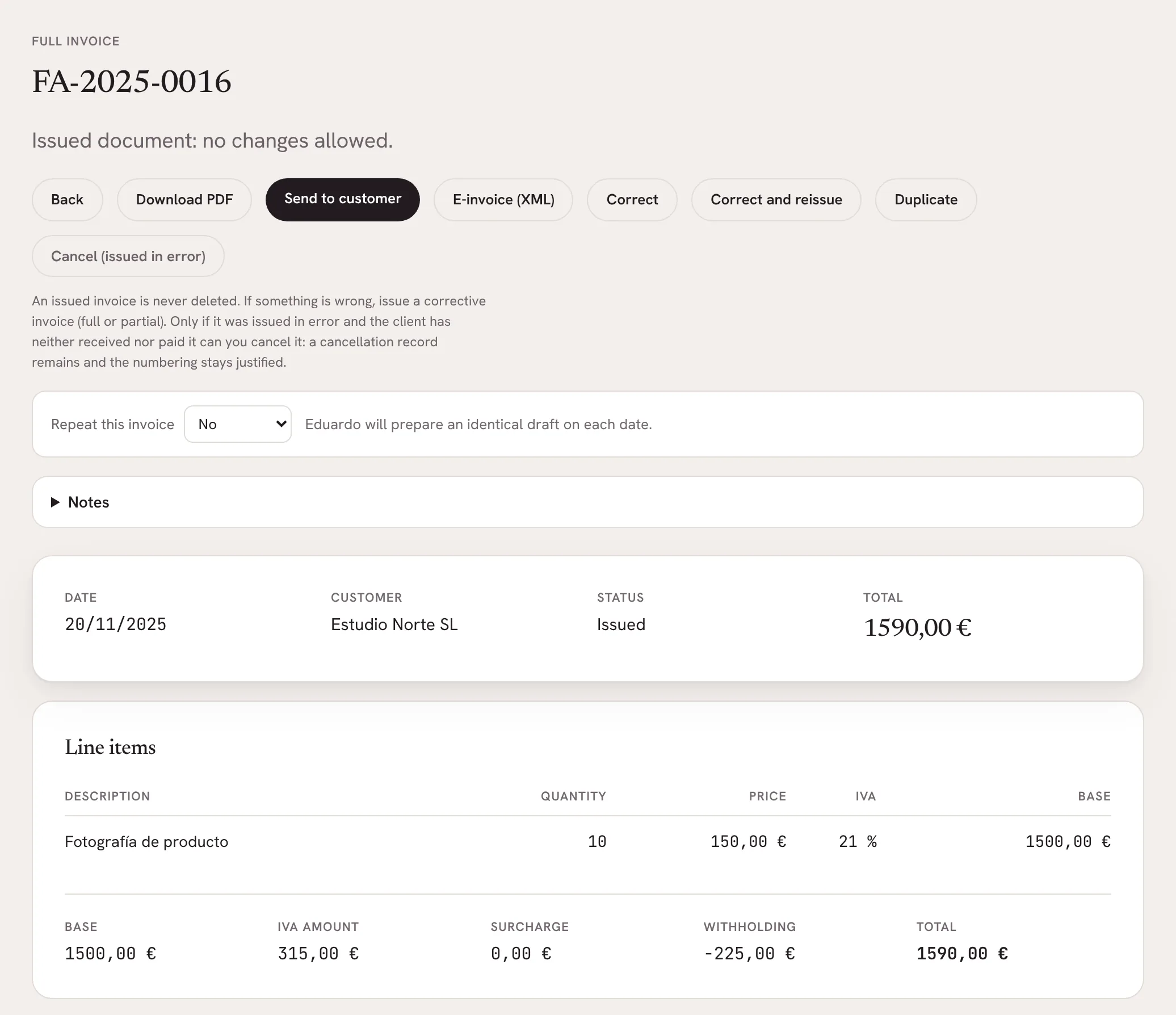
The chained record, the QR code and sending records to the AEAT are ready but not yet enabled, because they are not yet mandatory; for this reason invoices do not yet carry a QR code or the «VERI*FACTU» wording. They will be enabled before they become mandatory (October 2028, under Royal Decree-law 43/2026), and you will be told in advance what you need to authorise. Check anything specific to your case with your adviser.
Frequently asked questions
When does VERI*FACTU become mandatory for autónomos?
Under Royal Decree-law 43/2026, the date matches mandatory B2B e-invoicing: October 2028, for both autónomos and companies (pending ratification by Congress). Until then it is voluntary.
Do I have to send my invoices to the tax office myself?
Not manually. In VERI*FACTU mode the software sends a record of each invoice as you issue it. In non-reporting mode it stores signed records and you only hand them over if the AEAT asks.
Is VERI*FACTU the same as mandatory e-invoicing?
No. VERI*FACTU covers the software you invoice with and the record of each invoice. Mandatory B2B e-invoicing under the Crea y Crece law is a separate obligation, set out in Royal Decree 238/2026. Since Royal Decree-law 43/2026, both deadlines coincide: for autónomos, October 2028.
I live in the Basque Country or Navarre. Does it apply?
Not in this form: the regional (foral) systems apply there, such as TicketBAI and, in Bizkaia, Batuz. Check your provincial tax authority's rules.