Guides
Modelo 130: quarterly income tax for autónomos
Updated on 26/11/2026
Modelo 130 is the quarterly income-tax (IRPF) prepayment for autónomos taxed under estimación directa, Spain's actual-profit method: you pay 20% of your year-to-date profit (19% from 2027 if your turnover is under €250,000, under Royal Decree-law 43/2026) so that the tax is spread over the year instead of falling due in full with the annual return (the renta, filed April to June). This guide covers who is exempt, a worked example and the treatment of negative results. It is general information, not tax advice: check your case with an adviser (asesor or gestoría).
What it is and why it is cumulative
It is set out in art. 99.6 of the Income Tax Act (Ley 35/2006) and arts. 109 to 112 of its Regulations (RIRPF). You apply 20% to net profit (income minus deductible expenses) from 1 January to the end of the quarter, then subtract what you paid in earlier quarters and the tax your clients withheld from your invoices.
20%
of year-to-date net profit
70%
of income with withholding: threshold to be exempt
€100
maximum reduction per quarter
It is not an extra tax: everything paid through the 130 is credited in your annual return (modelo 100), in the same way as the withholding on your invoices.
Who does not have to file
If you carry out a professional activity and in the previous year at least 70% of that income had IRPF withheld (retención), you are exempt (art. 109.1 RIRPF). A similar rule applies to farming.
Carmen, a building surveyor in Zaragoza
In 2025 she billed €38,000: €30,000 to Spanish construction firms (15% withheld) and €8,000 to private clients. 79% of her income had withholding, so in 2026 she is not required to file the 130. If in 2026 she works mainly for foreign or private clients, she will have to file again in 2027.
- Business activities (shops, hospitality, most trades) almost always file, because their invoices carry no withholding.
- Invoices to foreign clients and private individuals never carry withholding. If they are most of your income, you file the 130. This is the usual situation for expat freelancers working for clients abroad.
- If you start trading this year there is no previous year; the ratio is assessed on the current year. Ask your adviser whether to file from Q1.
Deadlines and a worked example
Same calendar as VAT: 1–20 April, July and October, and 1–30 January for Q4 (for Q4 2026, most likely until 1 February 2027, as 30 January is a Saturday).
Alex, a web developer in Seville
Most of his clients are private individuals or companies outside Spain, so he files the 130. In Q1 he earns €9,000 with €2,500 of expenses; one Spanish client withheld €450. By the end of Q2 he has €19,000 of income, €5,000 of expenses and another €450 withheld.
| Box | Q1 | Q2 (year to date) |
|---|---|---|
| 01 Income | €9,000 | €19,000 |
| 02 Deductible expenses | €2,500 | €5,000 |
| 03 Net profit | €6,500 | €14,000 |
| 04 20% of box 03 | €1,300 | €2,800 |
| 05 Paid in earlier quarters | €0 | €850 |
| 06 Withholding to date | €450 | €900 |
| 07 Payment due | €850 | €1,050 |
Income is declared excluding VAT. Expenses include your social-security fee (cuota de autónomo), gestoría, software and depreciation. Under the simplified method (estimación directa simplificada), the 5% allowance for hard-to-justify expenses (max. €2,000 a year; for 2026, 10% and €3,000, already in the Q4 130, under Royal Decree-law 43/2026) is often already included in the 130; otherwise it is applied in the annual return.
Reduction for low earners (art. 110.3.c RIRPF)
If your net business profit in the previous year was €12,000 or less, you deduct a fixed amount every quarter (box 13):
| Previous year's net profit | Reduction per quarter |
|---|---|
| Up to €9,000 | €100 |
| €9,000.01 to €10,000 | €75 |
| €10,000.01 to €11,000 | €50 |
| €11,000.01 to €12,000 | €25 |
| Over €12,000 | €0 |
Example
Paula, a yoga teacher in Granada, had net profit of €10,400 in 2025. In each 2026 return she deducts €50, so she prepays €200 less over the year. The reduction lowers the amounts prepaid, not the final tax liability.
Settlement boxes and negative results
- Box 12: total of the payments for each activity (box 07, plus box 11 for farming).
- Box 13: the art. 110.3.c reduction.
- Box 15: negative results from earlier quarters of the same year not yet used.
- Box 16: mortgage deduction for a main home, only for those still under the transitional rule for purchases before 2013.
- Box 19: final result, to pay or negative.
A negative result is never refunded: you file showing zero or a negative amount and offset it in the following quarters of the same year. Anything overpaid is recovered in your annual return. Because the calculation is cumulative, a quarter with lower profit automatically reduces the next payment.
Corrections
If you underpaid, file a supplementary return (complementaria, or an amended return if the AEAT has enabled it for the 130), with a surcharge if late. If you overpaid, the next quarter absorbs it through the cumulative calculation.
How Eduardo helps
Eduardo calculates the cumulative 130 from your income and expense books, applies the reduction if you enter last year's profit in Mi actividad (My activity), and checks your share of income with withholding so it can tell you when you might be exempt. «Descargar fichero para la Sede» downloads the import file for the AEAT form.
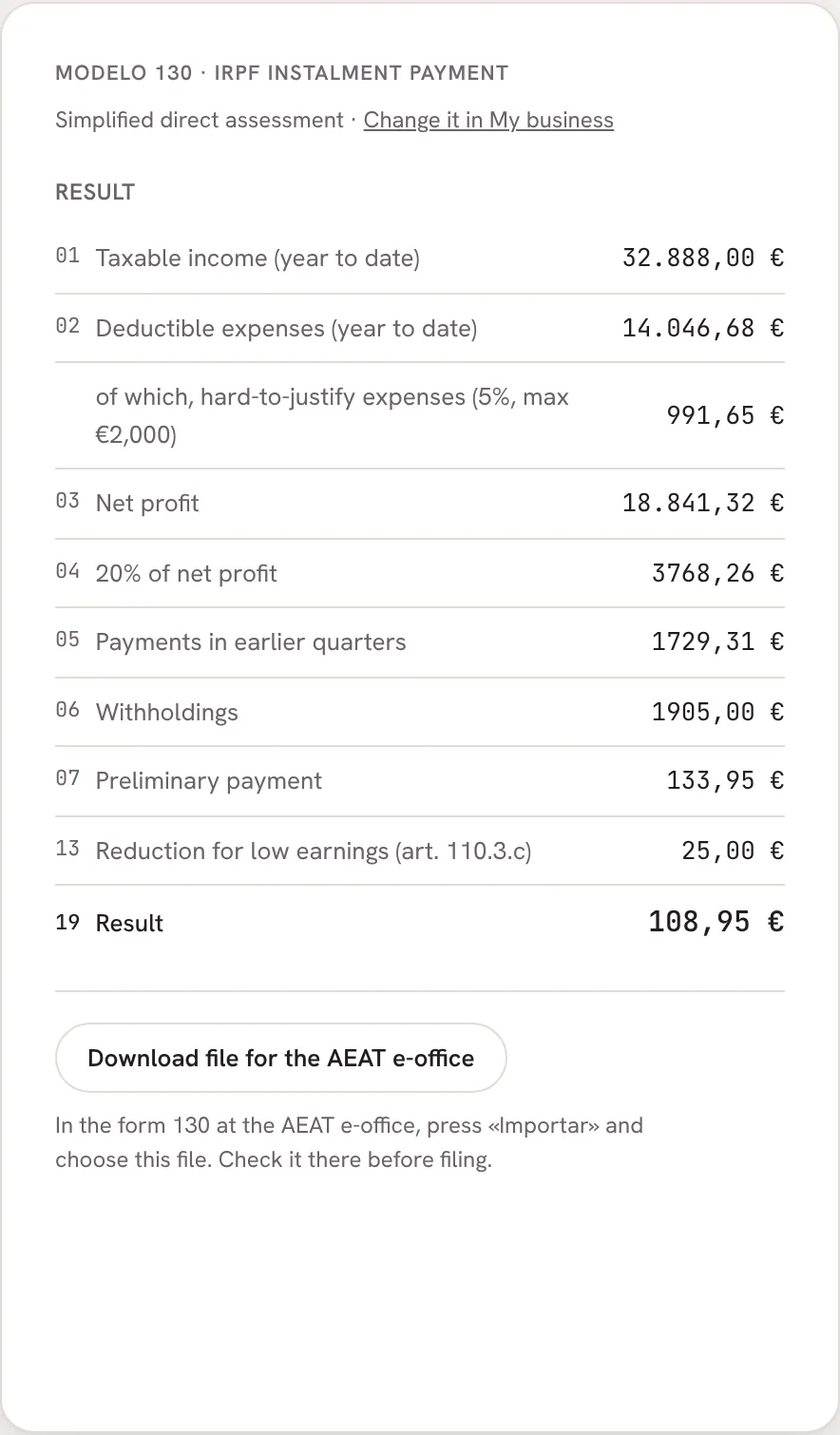
You or your gestoría file it. In your first year with Eduardo, compare the year-to-date figures with anything billed earlier in another tool, and check any doubt with your adviser.
Frequently asked questions
Does every autónomo have to file modelo 130?
No. Professionals with at least 70% of last year's income subject to withholding are exempt, and those taxed under the módulos system file modelo 131 instead.
Do I file if the result is zero or negative?
Yes. If you are required to file, you file every quarter even with nothing to pay. A negative result is not refunded; it is offset later in the year and in your annual return.
Is income in the 130 with or without VAT?
Without. The VAT you charge is not your income; it goes in the 303. Expenses also go in net of VAT, except VAT you cannot deduct, which counts as part of the cost.
Can I add withholding to foreign invoices to avoid the 130?
No. Withholding only applies to invoices to businesses and professionals in Spain. You cannot apply it to private individuals or to clients abroad.